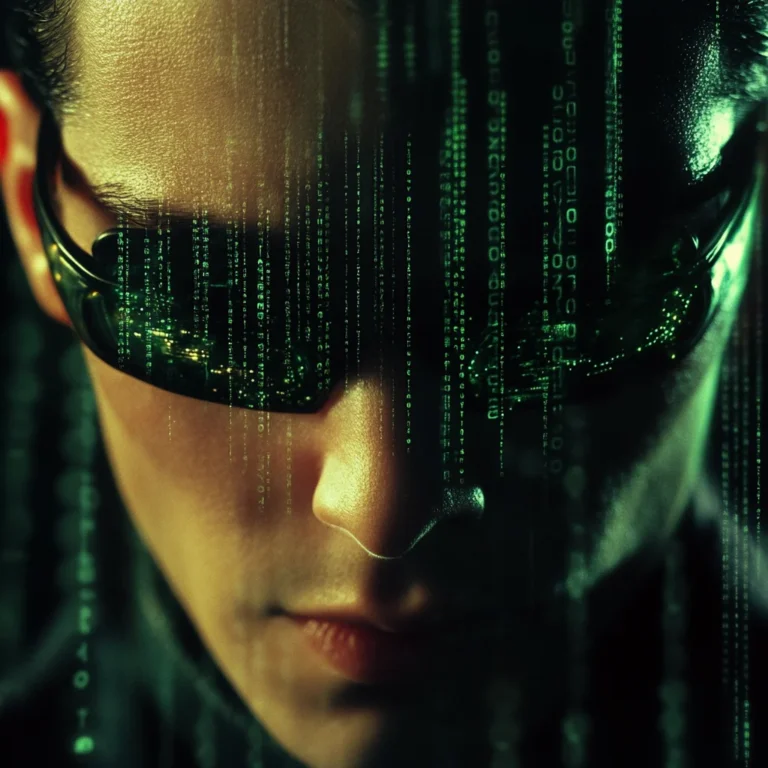
The Matrix movies blend mind-bending action with deep philosophy and stunning effects. Explore surprising secrets behind the scenes and the meaning within the Matrix saga. From sushi-inspired code to real clubs and revolutionary filming, discover what makes the Matrix truly iconic.
Matrix
The iconic green code in Matrix’s opening sequence is actually sushi recipes from a Japanese cookbook.
Neo’s room number in the film is 101, symbolizing the basics of reality and control systems.
Trinity’s fight scene was shot with a complex rig of over 100 cameras to create the famous bullet-time effect.
The S&M nightclub where Neo meets Trinity is a real club called The Hellfire Club in Sydney.
The Wachowskis originally conceived Matrix as a 600-page comic book script.
Neo’s costume trench coat was made from an inexpensive synthetic fabric printed to look like wool.
Keanu Reeves had back surgery before filming but still trained four months for the difficult fight scenes.
Morpheus’s ship, the Nebuchadnezzar, is named after an ancient Babylonian king.
The Matrix contains repeated background characters—twins and triplets—that hint at glitches in the simulated world.
Neo’s file shown during interrogation reveals his birthdate as March 11, 1962, making him 37 in the real world timeline.
The agent Smith character was inspired by elements from Neil Gaiman’s Sandman comics and The Invisibles.
The bullet-time sequence was created using 120 still cameras triggered in perfect sync.
The film’s color grading uses green tint for scenes inside the Matrix and a blueish tint for the real world.
The movie includes subtle foreshadowing, like the phrase “You need to unplug,” hinting at Neo’s path to freedom.
Some actors studied philosophical works such as “Simulacra and Simulation” by Jean Baudrillard to better understand the film’s themes.
How useful was this post?
Click on a star to rate it!
This AI-assisted post was rigorously curated and fact-checked for accuracy by:
Viggo Mortensen is more than just Aragorn—he’s a seasoned actor, poet, photographer, and publisher with a rich multicultural background. Discover fascinating insights into his multifaceted career and artistic passions.
Viggo Mortensen
Viggo Mortensen was born on October 20, 1958, in New York City and has Danish, American, and Argentine heritage.
He gained worldwide fame for portraying Aragorn in the epic “The Lord of the Rings” trilogy.
Mortensen pursues multiple art forms beyond acting, including photography, poetry, painting, music, and publishing.
He founded Perceval Press to support artists and authors whom mainstream publishers often overlook.
Viggo is known for his dedication to roles, learning new skills like horse riding and sword fighting for “The Lord of the Rings.”
He earned three Academy Award nominations, including for the films “Eastern Promises,” “Captain Fantastic,” and “Green Book.”
Mortensen began his career in films with a small role in Ridley Scott’s “Witness” (1985).
He is fluent in English, Danish, Spanish, and French, owing to his multinational upbringing.
Apart from Hollywood, Viggo has worked in independent films and international cinema, always choosing challenging characters.
He once infamously responded to a journalist’s rude question by flipping the bird—a testament to his passionate and sometimes fiery personality.
Mortensen’s interest in poetry and photography often intersects with his film projects, capturing behind-the-scenes moments and inspirations.
He is also a humanitarian, involved in social and environmental causes, often using his art and platform to highlight important issues.
Viggo has performed live readings of poetry and frequently collaborates with other artists across creative disciplines.
He speaks openly about his family life, including his three children and relationship with his wife, which gives him a down-to-earth aura.
Despite his fame, Mortensen maintains a somewhat private life and earns admiration for his humility and depth both on and off screen.
Will Smith transitioned from a teenage rapper to one of the most bankable movie stars in Hollywood history. He charmed audiences with his clean lyrics and charismatic acting style on television. Furthermore, he conquered the box office with massive hits that blended action and comedy perfectly. Consequently, the Fresh Prince remains a global icon in both music and cinema. Explore these fascinating details about the man from West Philadelphia.
Will Smith
Will Smith turned down the role of Neo in The Matrix to star in Wild Wild West. Consequently, he watched Keanu Reeves become a sci-fi legend while his own movie flopped critically.
He solves the Rubik’s Cube in under a minute, a skill he demonstrated in The Pursuit of Happyness. Remarkably, he learned this talent specifically for the movie and did not use a hand double.
He became a millionaire before the age of 20 thanks to his successful rap career. However, he spent the money freely and nearly went bankrupt due to unpaid taxes shortly after.
Teachers at his high school nicknamed him “Prince” because he could charm his way out of trouble. Later, he added the “Fresh” to create his iconic stage name.
He and DJ Jazzy Jeff won the very first Grammy Award ever presented for a hip-hop performance. They took home the historic trophy in 1989 for their hit song “Parents Just Don’t Understand.”
Will Smith stands at a height of 6 feet 2 inches (1.88 meters). Therefore, he often towered over his co-stars on the set of The Fresh Prince of Bel-Air.
Astonishingly, he holds the record for attending three movie premieres in three different countries in 24 hours. He set this Guinness World Record while promoting the film Hitch in 2005.
His wife Jada Pinkett Smith actually auditioned for the role of his girlfriend on The Fresh Prince. Unfortunately, producers rejected her because they thought she was too short next to him.
He is the only actor in history to have eight consecutive movies gross over $100 million in the US. This incredible streak cemented his status as the ultimate summer blockbuster star.
He improvised the famous “And what is that smell?” line in the movie Independence Day. He dragged the alien across the salt flats and came up with the dialogue on the spot.
President Barack Obama personally stated that he wants Will Smith to play him in a biopic. Furthermore, the actor has already spoken to the former president about the potential role.
He produced the hit Netflix series Cobra Kai through his production company, Westbrook Studios. Thus, he helped revive the Karate Kid franchise for a new generation of fans.
The phrase “Getting Jiggy Wit It” became popular worldwide because of his 1997 hit song. However, the slang term actually originated from Caribbean culture before he made it mainstream.
He can speak Spanish fluently and often conducts interviews in the language. He learned it to communicate better with his fans in Latin America and Spain.
Finally, he became the oldest person to perform the official theme song for the FIFA World Cup. He collaborated on the track “Live It Up” for the 2018 tournament in Russia.